Sycomore is one of the most extraordinary perfumes that I know. OK, its name looks like a misspelling of sycamore, a tree that – in Britain at least – no right-minded person would name a fragrance after. Sycamores, after all, are as common as muck, breed like rabbits and are often looked down on by ecologists as they’re not even native trees.
Acer pseudoplatanus, to give the tree its proper botanical name, is also responsible for many of those deeply irritating ‘leaves on the line’ excuses that railway companies give out each autumn to explain why their trains are running late. Worst of all, from a perfume perspective, they don’t even really smell of much, though their leaves do have the faintest leathery scent and their wood, once dried enough, burns with a pretty generic woodsmoke smell.
So is Sycomore just an example of misguided marketing, like Ralph Lauren’s dreadfully named Glamourous? Actually, no. Coming from arguably the world’s most tightly policed brand, its name will have been very carefully considered – and actually it almost certainly refers not, as I’d initially thought, to Acer pseudoplatanus at all but to a rather more exotic tree, the so-called Sycomore fig. Ficus sycomorus (to use its Latin name) is a large, spreading tree that grows all over the Middle East, where its heavy shade is much appreciated; it was known to the Egyptians as the Tree of Life. It’s a tree I haven’t sniffed, but my guess is that it shares at least some of the dry, green, slightly fruity scent that we know from other varieties of fig – though ironically there’s only the faintest hint of figginess in Sycomore.
Anyhow, enough about the name. What makes Sycomore extraordinary, for me, is a trick it seems to be able to do that no other perfume I’ve come across seems to be able to do. This is to smell like two completely different scents, depending on whether you smell it close up or at a distance. Up close it has the strong, earthy, pleasantly bitter scent of vetiver, the root of an Indian grass that’s related to lemongrass and citronella. It’s also grown commercially in the Caribbean, and apparently Chanel’s super-high-quality vetiver originated in Haiti.
Vetiver is usually classed as one of the great masculine fragrances, presumably because of its bracing bitterness and lack of cloying sweetness; it’s certainly not a flowery smell. But it also has a warmth and – get this – a touch of smokiness that gives it extra depth and complexity, especially when it’s surrounded by such a delicious cushion of other scents, which mix smokiness with a slightly sweeter touch of fruit. Vetiver is also famous for its staying power, and a spritz of Sycomore can last you all day.
It’s the added fruitiness that, on occasion, one gets a whiff of when someone wearing Sycomore strolls by, and then it’s like a different, warmer, sweeter fragrance altogether, with hardly a hint of the vetiver that dominates the perfume on the skin. If it’s an intentional trick I’m in awe, though it seems perfectly possible, given that Sycomore was created by Chanel’s chief nose Jacques Polge in collaboration with Christopher Sheldrake, the legendary British perfumer who has been Chanel’s director of research and development since 2005.
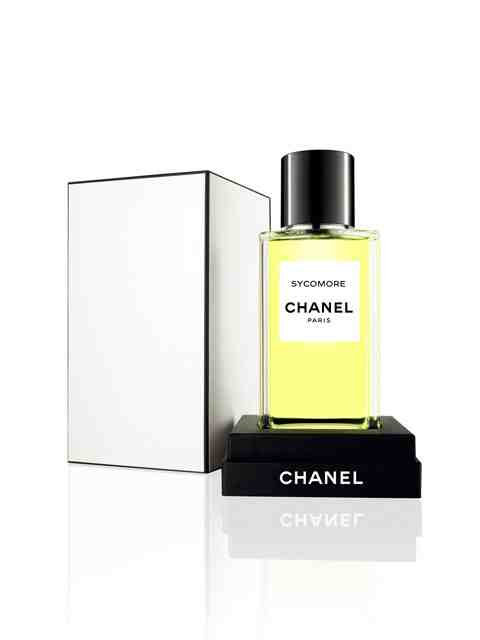
Like the other fragrances that belong to Les Exclusifs de Chanel, Sycomore costs about twice as much as your average perfume, but it does come in a typically (for Chanel) handsome bottle, beautifully presented in a chunky white-and-black box. The hidden magnet in the heavy black cap, ensuring that the iconic twin Cs of the Chanel logo always end up perfectly aligned, is a particularly nice touch, even if it has since been adopted by one or two other brands.
Though it’s a classically masculine scent Sycomore is (quite rightly) marketed as a unisex fragrance, and like most men’s perfumes it can smell wonderful on a woman. Yet what I love most is that, from the very first sniff, it has a wonderful feeling of luxury, quality and depth, which are things that are all too often lacking in other perfumes. And who could resist its baffling cleverness, like a cryptic crossword in scent?
 It sounds an idyllic conjunction of smart new houses and bucolic charm, though the fields were probably pegged with people’s washing and the mud, in wet weather, must have got everywhere; no wonder so many old houses have boot scrapers built into their walls. Since then the nearest countryside may have receded by fifteen to twenty miles, but if you have an architectural eye then you can still clearly distinguish the old urban boundary, beyond which the houses are generally late eighteenth-century and Victorian.